Category Archives: Region

Go down Moses

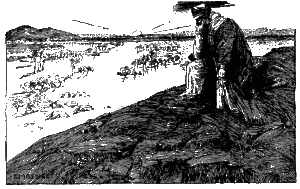
MOSES_WENT_UP_INTO_A_HIGH_MOUNTAIN,_FROM_WHICH_HE_COULD_SEE_THE_LAND_HE_WAS_NEVER_TO_REACH.

How was the world oriented north? We take it for granted that north is up because you place the more important things on top. But does this mean that people in the South must feel forever inferior? To counter this psychological disadvantage, it is important to understand the historical processes that led to this arrangement.

The most obvious point of reference is the map. Who decided that North was up? It seems that the vertical orientation of the world map was developed during the Italian renaissance, accompanying the great voyages of discovery by Columbus and co. Before that, the Arab maps were oriented upside down to us, with the south up. So as the practice of map-mapping passed from Eastern to Western empires, was it informed by a particular north-orientation in the Judeo-Christian tradition?

We are now on the verge of the great Jewish ritual of Passover, which commemorates the escape of the Jews from Egypt to find the promised land of Israel. In the Bible, the relationship between Egypt and Israel is vertical. In Genesis, Abraham goes ‘down into Egypt’ to escape famine (10). Later Joseph is brought ‘down to Egypt’, followed by his brothers (39). And the Exodus (32), Moses is described as the man that brought the Jews up out of the land of Egypt.

At the Passover feast, those gathered for the Passover feast read from the Haggadah, which includes the Afro-America spiritual Go Down Moses, expressing the hope among slaves that they would find a Moses to release them from bondage. William Faulkner’s story of the same name clearly identifies Pharaoh as the white slave master.

Up and down feature elsewhere in the Bible, but not along the north-south axis. The Book of Ezra tells the story of the Persian king Cyrus who invaded Babylon and released the Jews from bondage. Though himself a Zoroastrian, Cyrus had a great respect for other religions and won the allegiance of Babylonians by praying at the temple of Marduk. He also vowed to help the Jews re-established their great temple in Jerusalem. Cyrus proclaimed, ‘Anyone of his people among you—may his God be with him, and let him go up to Jerusalem in Judah and build the temple of the LORD.’ Though the trajectory from Iran-Iraq-Israel is along the east-west axis, it is still a matter of going ‘up’ to Jerusalem.

The particular Jewish arrangement of cardinal points seems quite independent of this vertical axis. The most important direction is Kedem, or east, towards which everything of importance is directed. They share with the Arabs an understanding of North as left and South as right.

The Hebrew word for ‘go up’ is aliyah. At one level, it describes the process of migrating to Israel, from the exiles of ancient Babylon to the more recent diaspora from Russia. At a more immediate level, it also describes when someone is called in the Synagogue to come up to the front and read from the Torah.

The opposite of aliyah is yerida, to go down. This is clearly a less desirable direction. There is even today argument about whether Abraham sinned when he committed yerida in going down to Egypt. One interesting paradox is yerida l’tzorich aliya (go down in order to come up), as evident in the folk wisdom about the necessity of hard times to acquire knowledge of the world.

So, the vertical root that surfaces in the Renaissance seems to strike deep in the Judeo-Christian tradition. But where does it begin? It becomes more difficult to find sources, but there’s an interesting resonance in the culture of Babylon itself. The creation epic known as Enûma Eliš is one of the first references to a sacred domain above. It pictures the beginning of the world… ‘When in the height heaven was not named,/And the earth beneath did not yet bear a name…’

And where did the Babylonians acquire their verticalism from? Where do we stop?

From the Judeo-Christian roots, we have a better understanding of why it is important whatever is given the elevated position. But it still does not explain how this privilege was granted to the North. We may have to go back to the Renaissance for that answer.

Thanks for Bernard Rechter and Paul Forgasz for their assistance with this issue.

Is Canada south?

In 1964, the Canadian pianist Glenn Gould took the Muskeg Express, a train that travels north more than 1,000 kilometres from Winnipeg to Churchill, in the upper reaches of Manitoba. At breakfast, he struck up a conversation with a surveyor Wally McLean and was impressed to learn about his ‘craft’ which was ‘to find in the most minute measurement, a suggestion of the infinite’.

Gould subsequently invited Wally to be the narrator for a radio documentary called the Idea of North. The one hour program included five voices in a contrapuntal structure that interwove varying strains of romanticism, cynicism and reflection. The nurse Marianne Schroeder describes her initial fears about the monotony of the North and how she began to identify with its innocent beauty. Frank Vallee criticises attempts at ‘northmanship’ where one seeks to outdo the other in experiences of remoteness.

Gould was notorious for eschewing the concert hall and retiring to the privacy of the recording studio. Accordingly, what interested Gould in the North was the experience of solitude. He identified with austere Nordic composers such as Sibelius, Bach, and Schoenberg.

Out of this isolation emerges a nation. Fellow Canadian composer R. Murrary Schafer stated that ‘All the energy of the world radiates from the Magnetic North Pole.’ One of the prophets of Canada’s north was Vilhjalmur Stefansson, an Arctic explorer of Icelandic descent. In 1922 he wrote ‘There is no northern boundary beyond which productive enterprise cannot go until North meets North on the opposite shore of the Arctic Ocean.’ This North is Canada’s frontier.

For Jim Lotz, Canada is founded on those parts of the North American continent that few others wanted. The North thus becomes a secret appreciated only by Canadians. Kevin McMahon describes the Arctic as Canada’s own mythological territory, defining nationhood in the same way that the Wild West defined the USA and the open seas defined England.

There have been attempts to broaden this idea of North beyond Canada. In Peter Davidson’s Idea of North, he notes the visit to St Petersburg in 2003 by the Canadian Governor General Adrienne Clarkson. She proposed to the Russians a ‘new humanism of the North’ shared to reverse the southern perspective that sees the far North only as a region to be exploited for its natural resources.

Canadian identity is grounded in the North. In her Canada and the Idea of North, Sherrill Grace quotes Henry Beissel’s Cantos North (1982) that the north ‘discovered us / fell upon our vanity / with tomahawks of ice’. Grace describes the Canadian idea of North as a habitus— a deep-seated phenomenological orientation that informs the Canadian sense of self.

It’s an interesting challenge with which to begin a journey to the idea of South. To what extent might the idea of South that we are exploring here be a version of the Canadian idea of North? Both might entail concern for a region that needs protecting from the rest of the world. A sense of inferiority becomes a noble mission.

And on the other hand, is Canada south? If you take colonisation as the common element linking countries of the South, then Canada shares much in common with settler nations like Australia and South Africa. A recent book by Joan Fairweather identifies the common cause shared between Canada and South Africa in the land claims of their Indigenous peoples.

So why couldn’t Canada be South? This question brings into relief the physical sense of South, evident in the weather, the skies and the nature. It points to a problem that an idea of South must resolve: how to reconcile the historical trajectory of the South with its physical reality. Canada puts that question on our agenda.

It also raises the possibility that the division between North and South may not be binary. If South is defined in opposition to a dominant North, then North eventually becomes South when its power wanes with distance in whatever direction. This is the idea of South as periphery. And if for Europeans the South is the realm of sunshine, then in countries like Australia, the northern state of Queensland is more south than Victoria below it.

These complexities prompt a dynamic concept of space. But how elastic can an idea of South be before it loses its meaning? Where does South end? What is the limit of South?

References

Listen to the start of Glenn Gould’s Idea of North

  • Peter Davidson The Idea of North London: Reaktion, 2005
  • Joan G. Fairweather A Common Hunger: Land Rights In Canada And South Africa Calgary: University of Calgary Press, 2006
  • Sherrill Grace Canada and the Idea of North McGill-Queen’s Press – MQUP, 2002
  • Jim Lotz Northern Realities: The Future of Northern Development in Canada Toronto: New Press, 1970

The South has no idea, really

It can be useful to consider the doubts that beset the South. In a way, it’s repeating conventional wisdom to claim that the North is more significant than the South, but it’s important to acknowledge it at some point in this journey. At least we know what we are up against. Treat it as a crude provocation. Rebuttals are most welcome.

Let’s face it, North is where the action is.

  • There are four times as many people living in the northern as in the southern hemisphere.
  • The South is mostly water. Two thirds of the continents are in the North.
  • The earth is magnetised so that all our compasses point north.
  • Since the breakup of Gondwana, even southern continents have been moving steadily northwards. Africa will eventually be joined to Europe.
  • The South is mostly islands. Isolation leads to inferior evolution — look at the flightless birds.
  • Colonisation was an unfortunate but inevitable confrontation between the superior interconnected empires of the North and the fragmented independent kingdoms of the South.

The superiority of the North is partly due to its curiosity for the unknown. An idea of South emerges not from anything within the South, but from the missionary impulse of the North itself. The South sees itself through the lens of northern primitivism.

The South may chose to turn its back on the North, but this will only isolate it further from the source of new ideas and resources. Nations like South Africa, Australia, New Zealand and Chile were formed by empires from the North and so are destined to judge themselves according to Northern values. They may achieve significant feats in their own hemisphere, but they will never contribute anything original to the source of their nationhood in the North.