Category Archives: Country

Uruguay also exists

image
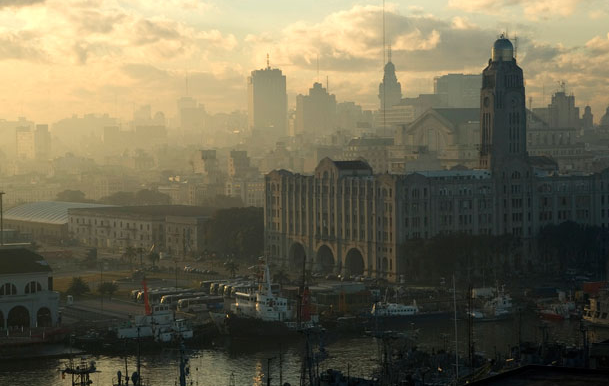
Montevideo, Uruguay

Looking from above, we often search for glimpses of north-ness down in the South. Along with the glittering Paris’s and Venices of the South, there are several locations that lay claim to the title ‘Switzerland of the South’. Each identifies with different elements of Switzerland. For Tasmania, it is the picturesque mountain scenery. In the case of New Zealand, it is libertarian values. But the title has seemed particularly apt for a tiny nation wedged between the super-powers of South America.

Uruguay was crowned the ‘Switzerland of South America’ in the first decades of the 20th century. Nature had little to do with this title. It resulted more from the European social democratic system of liberal values and tax laws introduced by President José Batlle y Ordoñez. For a period, Uruguay was blessed by a prosperity ornamented with art deco architecture.

Yet there are less idyllic aspects of Uruguayan history not so visible from high above. Down on the ground, we find a fiercely political contest between conservative and radical forces. In the mid 19th century, a nine year civil war pitched the conservative whites, supported by Argentina and based in provinces, against the liberal reds, supported by European interests and concentrated in Montevideo.

The North took great interest in this battle. The siege of Montevideo was compared by Alexander Dumas to the Trojan War. Giuseppe Garibaldi led the Italian legion in the eventual liberation of the capital. Europe cheered the liberal urban elites in their struggle against the feudal lords.

The political conflict during the 20th century was more internalised. During the 1970s and 1980s, Uruguay experienced a period of military repression which was particularly brutal, even by comparison with its neighbours. At one stage, Uruguay had the highest per capita percentage of political prisoners in the world. Like most other neighbouring countries, Uruguay is now governed by centre-left President, Tabaré Vázquez.
image
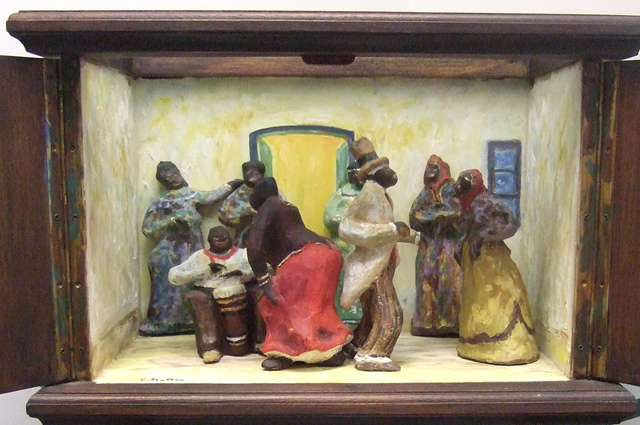
Ceramic cadombe scene (from Uruguay Embassy, Australia)

There is much in Uruguayan culture that is unique and different from the North. Unlike its neighbour Argentina, the culture of the African slaves survived to play a key role in defining its national identity. Candombe emerged in Montevideo as a dance performed by Africans in places called ‘tangos’. Today Candombe can be found as a procession of drummers who perform ‘llamadas’ (calls) as they march down streets—slowly to reference their previous life in chains. Competing tribes are distinguished by their own rhythm.

image

Also associated with carnival is Murga, a form of musical theatre derived originally from Cadiz, Spain. Murga is a play combining songs and recitative performed by a group of brightly dressed men, who sing in harmony to the accompaniment of percussion instruments. The content is often subversive and associated with resistance to previous dictatorships.
image
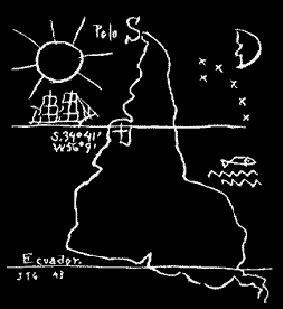
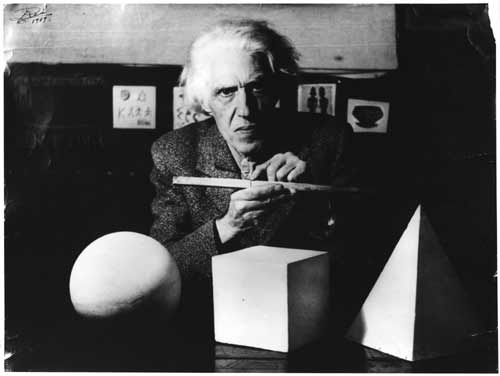
Joaquín Torres García El Mapa Invertido 1943
image
Joaquín Torres García

Leading cultural voices of Uruguay have strongly identified with its south-ness. The painter Joaquín Torres García lived in Paris during the 1920s, where he had been part of Pablo Picasso’s circle, and discovered pre-Colombian culture at the Trocadero. He returned in 1934 to establish the Escuela del Sur (School of the South), where he developed a movement unique to the South called ‘Constructive Universalism’. Torres García incorporated pre-Colombian symbols into a Western grid. For Torres Garcia, the South represented the future of art:

I have said School of the South: because, in fact, our North looks South. For us there must not be a North, except in opposition to the South… This correction was necessary; because of it we know where we are.[1]

image
Eduardo Hughes Galeano

The essayist Eduardo Hughes Galeano is a voice of conscience for Latin America as a whole. Books such as The Open Veins of Latin America and his three volume series Memory of Fire outline the brutal events that accompanied the emergence of Latin America. Recently in Democracy Now, Galeano described the cultural syndrome of impotence prevalent in the South:

…something condemning you, dooming you to be eternally crippled, because there is a cultural saying and repeating, “You can’t.” You can’t walk with your own legs. You are not able to think with your own head. You cannot feel with your own heart, and so you’re obliged to buy legs, heart, mind, outside as import products. This is our worst enemy…

For Upside Down World, he locates this lack of confidence particularly in Latin America:

All through the first half of the nineteenth century, a Venezuelan called Simón Rodríguez, travelled through the roads of our America, on a mule, challenging the new holders of power: “You,” Simon would cry out, “you who so imitate the Europeans, why don’t you imitate from then what is most important – originality?”

image
Mario Benedetti

The poet Mario Benedetti is equally famous across Latin America, though his politics is expressed in a more personal language. He began his writing career as a journalist, until his paper Marcha was shut down by the dictatorship. Bendetti was drawn out of Uruguay. Inspired by the 1959 Cuban revolution, he went to live in Paris during the early 1960s, when he wrote Noción de Patria (A Notion of My Country, 1962). This poem opposes imported models of place to the more authentic experience of unfamiliarity:

But now there aren’t any excuses left
Because it all relates back to this place
It always relates back to this place.
Nostalgia seeps out of books
And plants itself under my skin,
And this city that never sleeps,
This country that doesn’t dream,
Quickly becomes the only place
Where the air is mine
The fault is mine
And the sag in the mattress is mine,
And when I extend my arm I’m sure
About the wall I touch, or the emptiness that surrounds me,
And when I look at the sky
Over here, I see clouds, and over there, the Southern Cross
Everybody’s eyes make up my surroundings
And I don’t feel as if I’m on the outside
Now I know that I don’t feel as if I’m on the outside.

Maybe my only notion of my country
Is this urgent desire to say Us
Maybe my only notion of my country
Is this return to the uncertainly itself.[2]

After living in Havana during the late 1960s, Benedetti returned to Montevideo, where he founded a coalition of left-wing groups. Assassination attempts forced him to flee to Spain. Since his return, Benedetti has been a leading voice for the newly confident Latin America. In 2005, Hugo Chavez quoted his poem ‘The South Also Exists’ at the opening of the G-15 Summit:

With its French horn
and its Swedish academy
its American sauce
and its English wrenches
with all its missiles
and its encyclopedias
its star wars
and its opulent viciousness
with all its laurels
the North commands,
but down here
close to the roots
is where memory
no remembrance omits
and there are those
who defy death for
and die for
and thus, all together
work wonders
be it known:
the South also exists.

This performance by Joan Manuel Serrat responds to the vertical position of the South:[3]

New dimensions of Uruguayan culture are still being discovered. A publication by a 19th century anonymous Uruguayan writer has recently been unearthed. The Book of Disengagements is a series of aphorisms in the style of Ferdinand Pessoa, which celebrates non-being. In a very abbreviated form, they reflect the presence in absence where Uruguay seems to find itself:

You are nothing, true; but that nothing already is something.


Notes

Special thanks to Andres Pelaez for his assistance with this entry. Also see Carlos Capelán for a more complex perspective.

[1] Arnulf Becker Lorca ‘Alejandro Álvarez Situated: Subaltern Modernities and Modernisms that Subvert’ Leiden Journal of International Law 2006, 19, pp. 879-930

[2] Mario Benedetti Little Stones at my Window translated by Charles Hatfield, Willimantic: Curbstone Press, 2003
[3] A more politicised version can be found here.

A limit to South?

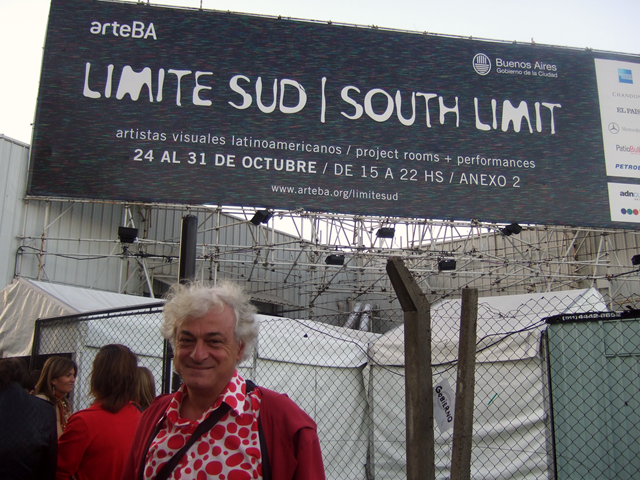
image Argentinean photographer Marcelo Brodsky at opening of Limite Sud

In late October, ArteBA launched Limite Sur | South Limit as an Argentinean add-on to the São Paulo Biennale. The title refers to the relation of Buenos Aires to São Paulo and bears no relation to the work inside. The event is structured like an art fair with booths for commercial galleries representing individual artists. The only tangential reference to an idea of South came from Javier Barilaro:

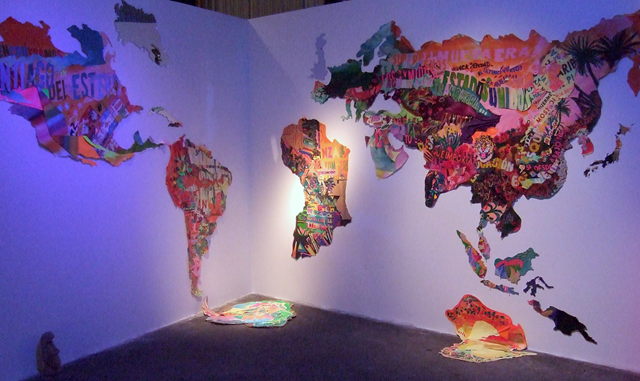
image Javier Barilaro Me desatino si me impongo un destino + un millón de colores de hielo (I am foolish if I impose a destination + million colors of ice)2008

Barilaro’s collage work depicts various nations with garish packaging as part of his overall project of popularism – Filosofía Combiera (Philosophy of the Cumbia). As often happens in Latin America, Australia falls off the map.

Like the Design Indaba theme It’s a South Thing in Cape Town, the use of ‘south’ in the Buenos Aires event is a pure branding exercise. How long will it be before someone bites the bullet and puts some content into the South concept?

Zimbabwe: The Colossus from the North Finds Ruins in the South

If I had a mother,
Oh Time, leave me alone.
She would offer me food when she ate herself,
Oh Time, leave me alone.
It’s only the gods who know,
Oh Time, leave me alone.
She would say, ‘Here you are my child’.

Patrick Chakaipa[1]

Now we take a sideways leap from the South Pacific to Southern Africa. Both parts of the world have evoked lost worlds and so lent themselves to Western primitivism. These romantic visions mask the often violent political realities of colonisation. But while Tahiti has retained its commodified tourist value, Zimbabwe has become symbolic of all that can go wrong in the South. Is the South inherently less civilised?

The history of Zimbabwe reflects a violent opposition between north and south. Once a thriving empire in its own right, Zimbabwe was crushed by northern colonists and is still yet to recover.

image The name Zimbabwe comes from the phrase, dzimba dza mabwe, which means ‘house of stone’. The legendary city of stone known today as Great Zimbabwe has been carbon dated by western methods back to approximately 600 AD. From the thirteenth century, the Maputa Empire traded gold along the Indian Ocean coast, in exchange for goods such as chinaware and Gujarat textiles. In the late 15th century, the empire split into two parts, Changamire in the south (including Great Zimbabwe) and Mwanamutapa in the north. Arabs still populated the trading towns.[2]

Then in the early 16th century, Portuguese traders began to arrive via Mozambique. In response, Swahili traders began to re-direct trade away from Portuguese dominated ports through alternative routes north. This began the decline of the Maputa Empire. Eventually, the Ndebele, fleeing the Zulu king Shaka, invaded and established their empire of Matabeleland.

image The British arrived in 1880s with Cecil Rhodes’ British South Africa Company. With intimations of the apartheid to come, Rhodes announced in 1887 that ‘the native is to be treated as a child and denied the franchise’

Zimbabwe was a special prize for Rhodes. He subscribed to the myth of the lost tribe of Israel in which the South is seen to contain remnants of Biblical stories. The legendary city of Ophir, the source of King Solomon’s wealth, was presumed to be that of Great Zimbabwe. The quest for biblical wealth became the subject of the novel King Solomon’s Mine by Ryder Haggard.

After having appropriated the Promised Land for Britain, Cecil Rhodes was given a burial that reflected both black and white cultures.[3] His body was carried north by train along his own railway in Bechuanaland (called by Rhodes ‘the Suez of the South’). The body of Rhodes was placed immediately after the engine, ‘so that even in death the great leader still led the way northward’. He was eventually buried in the Matopo hills, a traditional manner signifying his status as a deity of the land. In his will and testament, Rhodes proclaimed a universal Anglo-Saxon world government that would reunite Europe and the USA.

Rhodes’ colleague Lord Baden-Powell pursued the theatre of empire in Rhodesia during the Second Matabele War, when he established the art of scoutcraft to be taught to young boys. It was here that he fashioned the fleur de-lis as the emblem of his movement, so that the boys would always know the way north, no matter how far away they were from England.

Rhodes’ land eventually became Rhodesia, notorious for the apartheid rule of Ian Smith. In 1950, Doris Lessing’s first novel, the Grass is Singing, evoked the hatred fostered between black and white:

When old settlers say ‘One has to understand the country ‘, what they mean is, ‘You have to get used to our ideas about the native.’…

When it came to the point, one never had contact with natives, except in the master-servant relationship. One never knew them in their own lives, as human beings. A few months, and these sensitive, decent young men had coarsened to suit the hard, arid, sun-drenched country they had come to; they had grown a new manner to match their thickened sunburnt limbs and toughened bodies.[4]

image In the midst of this cold regime there were attempts to celebrate Shona culture. In 1966, the free-spirited Frank McEwen arrived from Paris where he brought a passion for primitivism to his new position as Director of the Art Gallery of Rhodesia. Seeking to engage the local culture, McEwen encouraged some museum guards to start carving soapstone and then started exhibiting their dreamlike creations. For Thomas Mukarobgwa sculptor McEwen, their ‘adult child art’ drew from the dormant cultures of Great Zimbabwe.[5] Freed of art education, their creations were ‘born directly, locally, from natural elements in the virgin ground’. McEwen organised successful exhibitions of their work in Europe and thriving market for their work ensued.

image While successful abroad, Shona sculpture is seen as disconnected from the political realities of life in Rhodesia.[6] A new generation of writers sought to depict the tensions between black and white, urban and rural. Charles Mungoshi’s The Setting Sun and the Rolling World reflects changes and separated generations. The father tries to convince his son to work the land, though he knows there is no future there

The sun was setting slowly, bloody red, blunting and blurring all the objects that had looked sharp in the light of day. Soon a chilly wind would blow over the land and the cold cloudless sky would send down beads of frost like white ants over the unprotected land.[7]

image Such divisions also separate writers themselves. Charles William Dambudzo Marechera was widely celebrated when he arrived in Europe brimming with negritude. He would say, ‘If you are a writer for a specific nation or a specific race, then fuck you.’ This nihilism was criticised in turn as an embrace of European modernism and denial of his roots.

image On the other hand, the playwright Ngugi wa Mirii remained in Africa to pioneer community theatre, particularly in Kenya. Until his recent death in a car accident, he was one of the most revered writers by the ZANU-PF movement.

While deeply divided over allegiances to global north and south, Zimbabwean culture has its own internal bearings. Shona traditions located the realm of the departed in two different regions.[8] Kubashikufwa is the land of ghosts deep underground, while Kwiwi is the land to the East is where the creator resides.

The South itself has particular meaning for the Venda, who journeyed into South Africa.[9] Their trek was accompanied by a drum called Ngowtu-lungundu, seen to play a role similar to the Arc of the Covenant. It was critically important that the drum never touch the ground in their southward journey.

image From the West, there are few countries in the world that seem as dysfunctional as Zimbabwe. The dispossession of white farmers and officially condoned violence seems to fulfil the worst prejudices of previous generations. Some allowance needs to be made for the fear and distrust that brewed during apartheid. But the challenge now is find a voice for Zimbabwe beyond fear and pity. The Chinese don’t seem troubled by this, and are happy to get down to business regardless of politics. When will the western world be open again to the words, songs, images and objects that emerge from this historic land?

The idea of South in Zimbabwe begins with a mythical lost world, which then unravels to a hell of violence and misery. Can we see beyond this idea to find a Zimbabwe of the future?

Notes

Thanks to David Jamali for his advice and encouragement. As the Zimbabwean proverb goes, ‘An elephant’s tusks are never too heavy for it’.

Next: Uruguay


[1] G. P. Kahari ‘Tradition, and Innovation in Shona Literature: Chakaipa’s Karikoga Gumiremiseve’ Zambezia , 2: 2, pp. 47-54

[2] Randall L. Pouwels ‘The Medieval Foundations of East African Islam’ The International Journal of African Historical Studies (1978) 11: 2, pp. 201-226

[3] Terence Ranger ‘Taking Hold of the Land: Holy Places and Pilgrimages in Twentieth-Century Zimbabwe’ Past and Present (1987) 117, pp. 158-194

[4] Doris Lessing The Grass is Singing Harmondsworth: Penguin, 1961 (orig. 1950), pp. 18-19

[5] Frank McEwen ‘Shona Art Today’ African Arts (1972) 5: 4, pp. 8-11

[6] Carole Pearce ‘The Myth of ‘Shona Sculpture” Zambezia (1993) 20: 107, pp. 85-103

[7] Charles Mungoshi The Setting Sun And The Rolling World : Heinemann International, 1989, p. 93

[8] Denys Shropshire ‘The Bantu Conception of the Supra-Mundane World’ Journal of the Royal African Society 1931, 30: 118, pp. 58-68

[9] A. G. Schutte ‘Mwali in Venda: Some Observations on the Significance of the High God in Venda History’ Journal of Religion in Africa Vol. 9, Fasc. 2. (1978), pp. 109-122.

Thabo Mbeki’s resignation

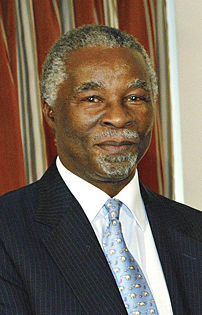
{{pt|O presidente da África do Sul Thabo Mbeki.On 21 September, the South African President Thabo Mbeki addressed the nation with the news of his resignation. In a well-discipline speech, he maintained his loyalty as a cadre of the movement and promoted the values of the ANC.

Mbeki spoke of the ‘age-old values of Ubuntu‘ on which their liberation movement is based. These values involved ‘selflessness, sacrifice and service in a manner that ensures that the interests of the people take precedence over our desires as individuals.’

Near the conclusion of his speech, Mbeki said that he departed his office:

knowing that this country has many men and women who have dedicated their lives to ensure that South Africa, Africa and the countries of the South will, in time, manage to ensure a better world for all of humanity.

South Africa strongly identifies with the South as a focus for both its political values and its unique contribution to the world. The next President has the challenge of continuing this story in a world where the division between North and South becomes less clear.

Voices from South Africa

image It’s rare to hear voices out of South Africa, other than those that confirm northern stereotypes of violence and disorder. If you are seeking an alternative view, then I would recommend the Victor Dlamini interviews. Dlamini talks with some of the lions of the South African literary scene, including Mbulelo Mzamane, Njabulo Ndebele, Breyten Breytenbach – the discussion with Lebo Mashile is particularly lively.

As much as what they have to say, it is the manner in which they say it which is important. The contemplative and reflective conversations say much about the inquiry that is part of the South African project today.