On 3 July 2014, the Australian Prime Minister Tony Abbott addressed the Australia-Melbourne Institute on the benefits of foreign investment. Himself an English migrant, Abbott praised the British colonisation of the continent as a far-sighted form of foreign investment.
Our country is unimaginable without foreign investment.
I guess our country owes its existence to a form of foreign investment by the British government in the then unsettled or, um, scarcely settled, Great South Land
The statement evoked criticism from a wide range of sources, mostly aimed at the idea that Australia had been ‘unsettled’ prior to the arrival of British settlers. But there are two other aspects worthy of note. The first is Abbott’s self-conscious vagueness: ‘I guess…’ and ‘unsettled or, um, scarcely settled’. This seems to be Abbott’s way of playing to his conservative audience, poking fun at political correctness.
The second is a little less obvious. The ‘Great South Land’ is an important construction in Abbott’s historical narrative. The description ‘Great South…’ or ‘Great Southern…’ is a familiar trope in Australian nationalism. It’s often added to anthems, names of hotels or businesses that attempt to proudly proclaim their Australianness. It has rarely been used politically until now, but Abbott has now tapped into the Eurocentrism that lies behind this epic title. This ‘Great South Land’ beckons opportunity, just waiting for an enterprising race to realise its potential. While we might hear strains of didgeridoo in the background, the real action is in pastoral development, mining and tourism.
This connection is made evident in the less common use of the phrase in Christian ministry. As this video tells, the Christian mission in Australia was foretold by the Jesuit explorer Quiros who discovered the continent in 1606 on the day of Pentacost, claiming it as ‘the Great South Land of the Holy Spirit’ (actually La Australia de Espíritu Santo). The singer Geoff Bullock engages this legend to construct a uniquely Australian Christianity.
But such a narrative remains steadfastly European. It depicts Australia as object of the European gaze, as an infinite land yet to be touched by civilisation. Like the other great nationalist trope, the Southern Cross, it is more about the remorseless extension of the familiar than engagement with the new. The challenge for Australia is to find a South for itself which is genuine – a South that does not contain within it a European exceptionalism, but offers instead a point of connection with other Souths across the periphery – Great Southern Lands.
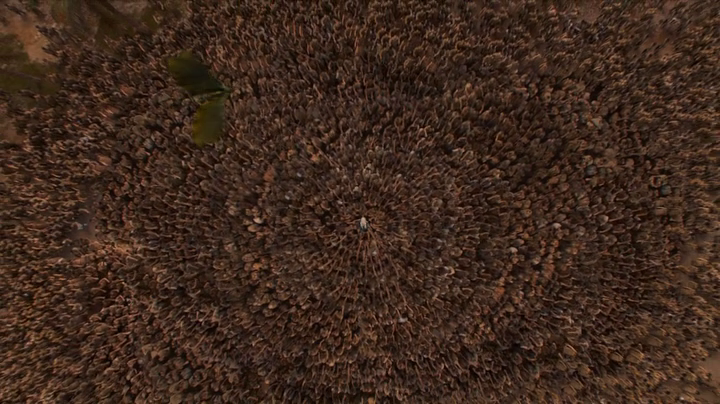
Final scene from the third series of Game of Thrones
The dizzying climax of the third season of Game of Thrones features the dragon queen Khaleesi walking into an encircling crowd of her newly ‘liberated’ people. As the dragons circle up to the heavens, the camera ascends, transforming the blonde queen into a speck of white at the centre of a sea of brown arms bowing to her in adoration.
It’s an ecstatic scene, worthy of the great expectations granted to the most popular narrative series since Harry Potter. But it’s also laced with a familiar irony. The blonde leader Khaleesi has establish a paradoxical form of domination based on freedom. Previously she had released the ‘unsullied’ slave warriors of Astapor from bondage, granting them freedom to come or go. In gratitude, they provide her with undying loyalty. The same logic applies with the Yunkish. Despite the violent overthrow of their city, the population welcome their liberator with an absolute devotion.
You don’t need to travel far in thought to reach the conclusion that this is a bold fantasy of Western power in a postcolonial world. Like the role of Jason Russell in Kony 2012, Western engagement with the rest of the world has enjoyed the idea that a single white individual can transform the lives of whole populations. This racial narcissism has an extensive lineage in Hollywood scenarios when heroes like Indiana Jones venture forth beyond the limits of European civilisation.
As such, this final scene would be a remarkably crude revival of this unilateral fantasy. However, in the broader cosmology of Game of Thrones, it has a particular narrative charge. At the core of the epic is a battle between North and South. The Starks are an honourable family speaking in broad Yorkshire accents, lead by brave men with dark beards. More than anything, Starks are true to their words. Their mortal enemies are the Lannisters, a priestly family, clean-shaven and without scruples when it comes to realising their family’s ambitions.
The conflict between the Starks and the Lannisters harkens back to the cultural fault-line in English history, between the democratic Anglo-Saxons and the hierarchical invading Normans. John Ruskin extended this binary to the division between the honest labour of the Gothic craftsman and the baroque ornamentation of the Italians – read godly Protestants and corrupt Catholics. Later versions include Manuel in Fawlty Towers and the representations of feckless Greeks in the recent financial crises.
The Northerners are given added gravitas in Game of Thrones as the guardians of the wall, a massive structure designed to keep out the wild creatures of the north. The coming winter threatens an apocalyptic invasion of Westeros. Thus the north-south conflict finds itself potentially outflanked by enemies from either end.
In this context, Khaleesi seems to follow the established narrative from the Second World War of the new democratic United States that has potential – aided by magical technology – to sweep away the tired rivalries of the Old World. But in re-creating this myth in 2013, they’ve had to transform GI Joe into a Zenobia-like warrior queen from the East.
The irony, of course, is that the effect of this freedom is to create conformity on a mass scale. The current concerns about mass surveillance by PRISM makes us particularly receptive to the compromises seen necessary to protect our freedoms.
However, given the savage narrative reversals that mark Game of Thrones, this great white hope is unlikely to magically resolve global conflict. In the next series, do we look forward to re-run of the second Iraq war, as the liberated turn upon themselves? It is the constant demand of the series to keep us on the edge of our seats that offers the most positive prospect for its geopolitical allegory.
Contrary to the usual talk about the rise of the Global South, The New North: The World in 2050 by Laurence Smith argues that climate change will favour the development of the Arctic region, where there is more land than the south. From his RSA talk
In 2050, Northern countries – notably Canada, Russia and Scandinavia – will rise at the expense of southern ones. Patterns of human migration will be dramatically altered – and where we are born will be crucial. But, argues UCLA Professor Laurence Smith, humans are adaptable: and there will be gains as a new world takes shape.
While there is logic in this argument, there is always the danger of a Northern triumphalism behind this story. It has the potential to soothe anxiety about a future where the energies of the Global South might seem to eclipse Europe and North America.
It is tempting to position the South as a victim of the North. Certainly, the conflict between the French North and South appears to be a story of ruthless oppressor that violently subjugates a peace-loving and tolerant victim. Is that necessarily so? Whichever way, French history straddles a cultural fault-line that continues to move in opposing directions.
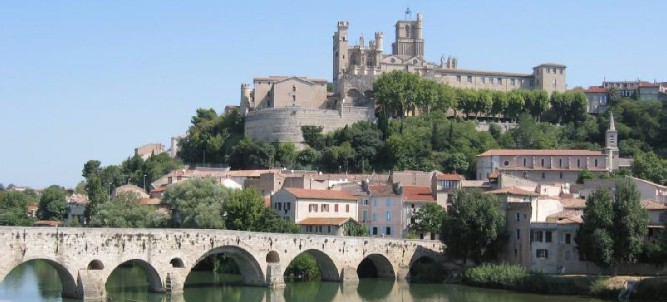
France contains at least two nations. While the north was populated by Franks from Germany, the south was a separate entity ruled by Visigoths in the Middle Ages. They were more closely connected laterally with the Catalans than vertically with the Franks. During its independent history, the South, known as Occitania, was a site of resistance to imperial rule.
Their first form of Christianity was Arianism, which taught that God came before Jesus. Around the tenth century, an interest in ‘courtly love’ emerged under the influence of poetry from Andalusia. The word “troubadour” was derived from an Arabic root ta-ra-ba meaning “to be transported with joy and delight”. The literary genre of ‘chanson de geste’ emerged celebrating refinement of taste in contract to the tales of war and heroic deeds prevalent in the north.
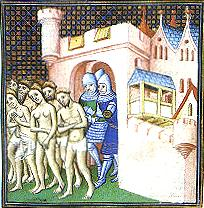
Cathars expelled from Carcassonne in 1209
At the same time, the religion of the Cathars developed, which denigrated earthly life and adopted values of simplicity and abstinence. In 1208, a Papal legate was assassinated in Saint-Gilles which prompted the Franks in support of Rome to cleanse the South of heresy. The Albigensian crusade led by Simon de Monfort became legendary for its brutality. In 1209 the town of Beziers was sacked and none of the population was spared, even those who sought refuge in the church. When the commander was asked by a Crusader how to tell Catholics from Cathars once they had taken the city, the abbot supposedly replied, Neca eos omnes. Deus suos agnoscet, “Kill them all, God will know His own.” The second crusade against the South involved the siege of Montségur (Montsalvat) during which the inquisition was first established.
The successful completion of the crusade led to the Frankish domination of the South and the status of France as a unified country. Nonetheless, the South continued to be a source of suspicion, characterised as stubborn and greedy. During the reformation, it contained Protestant strongholds. As administration became more centralised around Paris, French was enforced as the language of administrations.
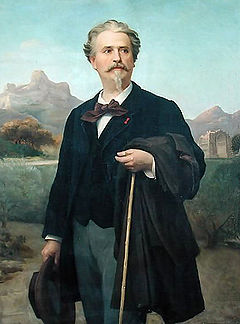
Frédéric Mistral
From the Revolution, the South was identified as a source of political change. Some autonomy was restored to the Midi, as it was now called. In the nineteenth century, writers such as Augustin Thierry and Michelet celebrated the South as a source of democracy. In 1854 Frédéric Mistral founded the Félibrige, dedicated to supporting Occitan literature, which gradually shifted to support for the Catholic Right. Inspired by his Nobel Prize in 1904, the Chilean poet Lucila Godoy Alcayaga changed her name to Gabriela Mistral. The mystical legend of Cathars was established by Napoléon Peyrat with the 1871 publication Histoire des Albigeois. But at the same time, there was pressure to standardise French under la Vergonha (the shaming), which prohibited the teaching of Occitan in schools. In reaction, the youth movement
Hartèra emerged to promote Occitan, as one of its posters says:
To hell with the shame…
Our patois is a language: Occitan;
Our South is a country: Occitania;
Our folklore is a culture.
We want respect for our difference.
Share, mix, walk!!
During the 1930s, there were attempts to identify the Cathars as ancestors of the Nazis, particularly through the romantic myth of Montsalvat. However, during Second World War, the area of France not occupied by Germans corresponded to that of Occitania. In 1940, editors of Cahiers du Sud, including Simone Weil and Louis Aragon called a gathering in Marseille to found a community of tolerance. As Weil said at the time, ‘Catharism was the last living expression in Europe of pre-Roman antiquity. It is from this thinking that Christianity descends; but the Gnostics, Manicheans and Cathars seem to be the only ones that remained faithful to it.’ After the war, the South became a site of creative experiment. In 1946, the Dada poet Tristan Tzara founded the Institut d’Etudes Occitanes in Toulouse.
Popular interest developed in 1960 with a two-part television series Les Cathares, drawing on Peyrat’s romantic history. The South became an issue in the revolutionary movement of May 1968
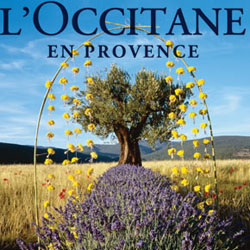
Now the South has become a significant luxury brand, associated with the region of Provencal in cuisine and home goods. Olivier Baussan founded the company l’Occitane, ‘L’OCCITANE has drawn inspiration from Mediterranean art de vivre and traditional Provencal techniques to create natural beauty products devoted to well-being and the pleasure of delighting and caring for oneself.’ This company has now extended its southern taste to other countries. The brand L’Occitane do Brasil expresses the authenticity of a first natural sun care line made exclusively in Brazil.
Part of the mythology of L’Occitane revolves around the ‘everlasting’ flower immortelle, the source of eternal youth.
Meanwhile, the flower has become a rallying point for revival of Occitan culture. In 1978, the band Nadau composed the song L’immortèla (The Edelweiss) which tells of the flower of love and the mountain journeys of the southern people,
Up we’ll walk, Little Peter, to the edelweiss
Up we’ll walk, Little Peter, until we find that place!
Occitania follows a familiar path in Europe, where civilisations known for their tolerance and poetry fall victim to the northern military regimes. This internal colonisation then provides the rehearsal for the subjugation of peoples beyond. Once the target of heresy has shifted to the colonies, then the internal other becomes a subject of nostalgia and commodification.
Rather than a single identity, countries like France seem constituted by a dialogue between opposing halves. While the heretic South helps to sharpen the values of the North, the brutality of the North conjures the idea of a sensual and tolerant South.
One way of reading an antipodean country like Australia is through the lens of its symmetrical opposites. For many, Australia has been compared to Nordic countries. One of Australia’s leading Nordicists, John Stanley Martin, unfortunately passed away this week. Here he talking about the commonality between Australia and Iceland.
John Stanley Martin, descendent of the Eureka rebels, went to Iceland to pursue a degree in Old Norse. He recalls a conversation with Icelandic novelist Sigurdur Nordal, who saw both nations as sharing the challenge of new beginnings:
As an Australian you understand Iceland better than the Europeans do, because we are Europe’s first colony. We are the first time they came. Every time there was a movement in Europe, there was always a group before—the Celts moving in, the Germanics moving in—and there would be an amalgam of the cultures… In Norway, from where they came, it was limited resources, someone gets more and someone gets less. Come to Iceland and it’s a free for all, grabbing land, so you don’t respect the environment in the same way any more.[i]
[i] John Stanley Martin, interview, 16 February 2001.

 Contrary to the usual talk about the rise of the Global South, The New North: The World in 2050 by Laurence Smith argues that climate change will favour the development of the Arctic region, where there is more land than the south. From his