Category Archives: Country

Australia-phobia in the Dressmaker

The global response to the 13 November Paris terror attacks have been understandably focused on its tragic impact on the lives of its population, on both those directly targeted by the terrorists and those who will fall victim to the increased fear that ensues. Some critical responses have attacked an exceptionalism that elevates the suffering of a European centre above more regular terrorist tragedies that occur in the South. What has not been commented on is the underlying affection the world holds Paris, not just as a privileged rich Western city, but also as a place of great beauty. With some distance from the tragic event, we can reflect on this romance, felt particularly intensely in a place far distant from the centre.

One of Melbourne’s contributions to the expression of global solidarity was the projection of the tricolour onto the edifice of the National Gallery of Victoria – International on St Kilda Road.

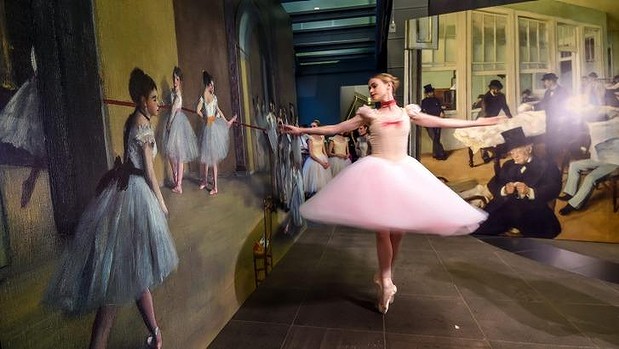
This was followed a few days later with the announcement of the Winter Masterpiece program for 2016 – an exhibition of French impressionist paintings Degas: A New Vision.

NGV Director Tony Elwood emphasised the scale of the exhibition: “It’s the most complex exhibition that the NGV and Art Exhibitions Australia has ever embarked upon”. Curator Ted Schell pointed out the connection with the Paris attacks:   “He’s the quintessential artist that expresses the essence, the life, the freedom, the joie de vivre of Paris in the late 19th century and we need that message to be carried, especially now after the tragedy of last weekend for poor Paris.”

The Paris attacks have raised a question about Melbourne’s position in the world. As an international city, it rightly joins others in the expression of solidarity with the citizens of Paris. But it also joins other cities at the bottom of the world in wanting a bit of Paris to itself.

Buenos Aires claimed the title ‘Paris of the South’ by modeling is central Avenida Cordoba on Baron Haussman’s urban design of the Champs-Elysees. Melbourne has the more modest claim of the ‘Paris end of Collins Street’, but it also has a romantic attachment to Paris in its unconscious. While its artistic heritage springs from the studios of Montmartre, intellectually its ideas are framed by the pantheon of French intellectuals, Barthes, Foucault and lately Rancier.

Winter Masterpieces is the most visible sign of this. Melbourne’s winter affords the opportunity to wear European clothes and become immersed in its grand art movements.  The program began in 2004 with Impressionists: Masterpieces from the Musee d’Orsay, followed by Dutch Masters, Monet, Dali, Art Deco, Picasso, Napoleon and last year the Hermitage.

There may seem nothing noteworthy in this. It is typical of middle class taste as found anywhere. But it’s particular significance for Melbourne has been revealed in a new Australian film.


Dressmaker has received a very warm reception as the latest instalment in a lineage of films including My Brilliant Career, Wake in Fright and Muriel’s Wedding. The plot involves a daughter returning to the small country town of her birth to deal with the trauma that caused her to leave – the claim that she had killed a boy.

The film makes much of the gothic scene of the remote Victorian town. Most of the trees are dead and the soundtrack is haunted by crows. The town’s inhabitants are seen as mean-spirited and provincial. The policeman Sergeant Farrat takes a fetishistic delight in the garments that Tilly Dunnage has brought back from Paris. He swoons over Dior and reveals his secret proclivity for cross-dressing.

But the power of the film is particularly in its casting. The presence of US megastar Kate Winslet as the returning daughter casts a stark shadow over the pathetic comic characters of Dungatar. Judy Davis plays her mother whose athletic feistiness shows up the dullish-nature of her neighbours.

Like Strictly Ballroom, the romantic interest is only found on the margins – in this case Teddy McSwiney from a poor family in the town camp. But the film exceeds its comic remit by consigning the whole town to flames at the conclusion. The haughty devastation brought on by Paris-trained daughter brooks no sympathy for the inhabitants whose lives are ruined, nor thought for the history of the town is extinguished.

The film ends with Tilly Dunnage on the train, approached by the conductor who asks where she is going. ‘Paris’ she says wistfully. Unperturbed, the conduct recites, ‘Hmm, well we stop at Ballarat, Broadford, Bacchus March and Melbourne’. Dunnage looks at him blankly. ‘Melbourne, then’.

Here then is the quintessence of Melbourne exceptionalism. It’s Paris end of Collins Street marks a distinction from the embarrassing ‘country towns’ that it finds company with at the end of the world. Here is the divide too readily exploited by reactionary voices that accuse the ‘latte set’ as out of touch with ordinary Australia. Is it possible the rapidly decreasing ‘ordinary Australia’ ends up as a myth, used to make those in its metropolitan centres feel closer to the north?

While Dressmaker does present a zero-sum game between French and Australian cultural pride, the final solution adopted in the conclusion is so extreme that it can serve to awaken some consciousness about local identity. The wish to destroy your own culture does seem the height of ‘bad faith’ (or indeed mauvais fois). The ever more dramatic negation of Australianness does seem to confirm its resilience. Indeed, why else are we still here?

I must confess to some discomfort in writing this post. The call to cultural pride in the face of foreign influence has a particularly nasty face in contemporary Australia, with the rise of neo-Fascist groups like Reclaim Australia that demonise Muslims. In today’s Australia, it’s hard to find expression of cultural pride that is sophisticated and cosmopolitan, rather than jingoistic or reactionary.

Maybe, in the end, that’s something Australia can learn from France, where national identity is tied to ethical values forged during the Enlightenment and subsequent revolution. Maybe Australia needs to be more French in order to dream less of being French.

Tony Abbott and the ‘great south land’

Tony Abbott delivers the keynote address at The Australian-Melbourne Institute conference. Photo: Getty Images

On 3 July 2014, the Australian Prime Minister Tony Abbott addressed the Australia-Melbourne Institute on the benefits of foreign investment. Himself an English migrant, Abbott praised the British colonisation of the continent as a far-sighted form of foreign investment.

As reported in the Sydney Morning Herald, Abbott said,

Our country is unimaginable without foreign investment.

I guess our country owes its existence to a form of foreign investment by the British government in the then unsettled or, um, scarcely settled, Great South Land

The statement evoked criticism from a wide range of sources, mostly aimed at the idea that Australia had been ‘unsettled’ prior to the arrival of British settlers. But there are two other aspects worthy of note. The first is Abbott’s self-conscious vagueness: ‘I guess…’ and ‘unsettled or, um, scarcely settled’. This seems to be Abbott’s way of playing to his conservative audience, poking fun at political correctness.

The second is a little less obvious. The ‘Great South Land’ is an important construction in Abbott’s historical narrative. The description ‘Great South…’ or ‘Great Southern…’ is a familiar trope in Australian nationalism. It’s often added to anthems, names of hotels or businesses that attempt to proudly proclaim their Australianness. It has rarely been used politically until now, but Abbott has now tapped into the Eurocentrism that lies behind this epic title. This ‘Great South Land’ beckons opportunity, just waiting for an enterprising race to realise its potential. While we might hear strains of didgeridoo in the background, the real action is in pastoral development, mining and tourism.

This connection is made evident in the less common use of the phrase in Christian ministry. As this video tells, the Christian mission in Australia was foretold by the Jesuit explorer Quiros who discovered the continent in 1606 on the day of Pentacost, claiming it as ‘the Great South Land of the Holy Spirit’ (actually La Australia de Espíritu Santo). The singer Geoff Bullock engages this legend to construct a uniquely Australian Christianity.

But such a narrative remains steadfastly European. It depicts Australia as object of the European gaze, as an infinite land yet to be touched by civilisation. Like the other great nationalist trope, the Southern Cross, it is more about the remorseless extension of the familiar than engagement with the new. The challenge for Australia is to find a South for itself which is genuine – a South that does not contain within it a European exceptionalism, but offers instead a point of connection with other Souths across the periphery – Great Southern Lands.

The idea of Antarctica

Invitation image to The Antarctic Kingdom of Gondwanaland
Invitation image to The Antarctic Kingdom of Gondwanaland by Wanda Gillespie

Edgar Allen Poe’s novel ‘The Narrative Of Gordon Pym’ (1838) evokes the belief, prior to the exploration of Antarctica, that a lost civilisation may be contained within its icy borders. Rather than the black-skinned inhabitants of deepest darkest Africa, this furthest reach of the world would reveal a race of Hyperboreans, with a culture that was foreign but comparable to the civilised West.

Poe’s tale concludes when the hero manages to escape the violence of dark-skinned natives by fleeing further south, until the waters mysteriously grew warmer…

The darkness had materially increased, relieved only by the glare of the water thrown back from the white curtain before us.  Many gigantic and pallidly white birds flew continuously now from beyond the veil, and their scream was the eternal Tekeli-li! as they retreated from our vision. Hereupon Nu-Nu stirred in the bottom of the boat; but upon touching him we found his spirit departed. And now we rushed into the embraces of the cataract, where a chasm threw itself open to receive us. But there arose in our pathway a shrouded human figure, very far larger in its proportions than any dweller among men. And the hue of the skin of the figure was of the perfect whiteness of the snow.

Rather than representing the end of the world, the icy wastes of Antarctica would turn out to be a means of keeping this other civilisation isolated from the rest of the globe.

Installation shot of The Antarctic Kingdom of Gondwanaland

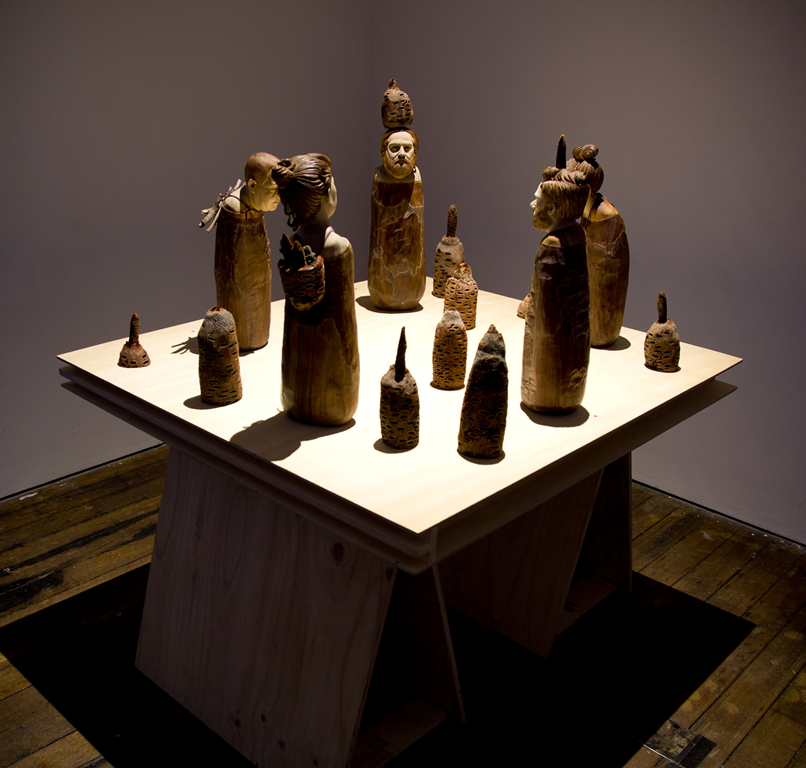
Today, the artist Wanda Gillespie has revived this myth in an installation at Craft Victoria titled The Antarctic Kingdom of Gondwanaland. The story behind this work is of the discovery of wooden artefacts in Queen Maud Land, Antarctica, as a result of global warming. It is suggested that these objects are from the same period as the ancient civilisations of Sumeria and Egypt. As the artist statement claims, ‘The meticulously crafted objects recovered from three initial archaeological missions suggest the culture may have been a precursor to such modern-day indigenous cultures of the South Pacific as Maori, Aboriginal Australian, Polynesian and East Indonesian.’

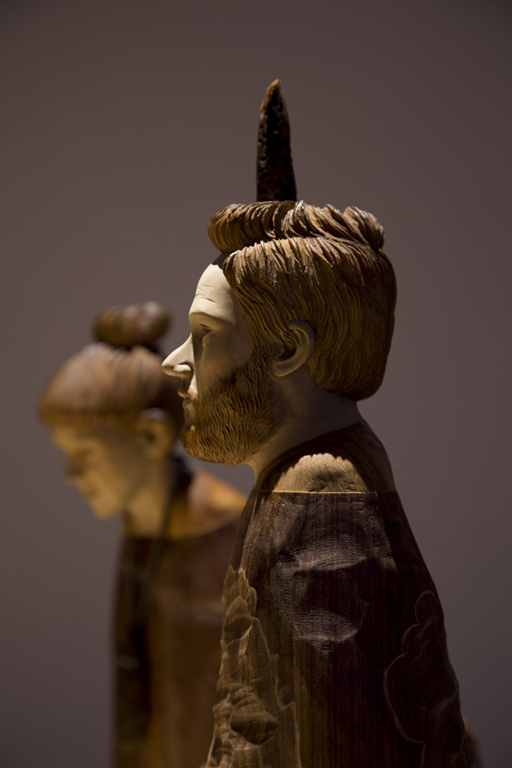
While the faces depicted are undeniably of European origin, the hair styles and demeanour suggest a Pacific culture, such as Maori. Gillespie surmises that these objects refer to a ceremony that attempt to ensure the safe passage of a spirit into the afterlife.

It’s a curious racial fantasy that white people preceded other indigenous groups to the South. It does have precedents, such as the notion that the Lost Tribe of Israel fled south thousands of years ago (shared broadly from Cecil Rhodes to Mormons). While the earlier fantasies had clear a imperial agenda, what does it mean to invent one today?

In Australia, the idea of one’s special relation to landscape has been largely given over to its Indigenous peoples, who are granted a privileged, if symbolic, relation to ‘country’. This is relatively easy arrangement for settler Australians as most live in cities, where there is little engagement with land, beyond real estate prices. But it would be argued that this does leave settler Australians with a undeveloped sense of place. Fair enough to give over country to traditional owners, but then what are you still doing here?

Detail of The Antarctic Kingdom of Gondwanaland

Antarctica seems immune to such issues, as it has no indigenous people. It thus provides a blank screen on which to project speculations about place and culture. One of the notable elements of Gillespie’s Hyperborean world is the prevalence of the banksia. This figures strongly in the early colonial imagination, which populated the bush with mysterious figures such as bunyips. So by this detour south, Gillespie seems to return to where she come from. She manages to imbue an otherwise sterile, commodified and urban world with the enchantment that once belonged to traditional societies, who had an active engagement in rites of passage, and believed there was something more than the sum total of individual interests.

As the world continues to warm, it will be interesting to see what more is revealed of this mysterious south.


Wanda Gillespie acknowledges Rodney Glick and Indonesian carver Made Leno (who produced the heads), writer Varia Karipoff and Alastair Boell from the Melbourne Guild of Fine Woodworking. Her website is http://www.wandagillespie.com/

Yantra from Ahmedabad

image

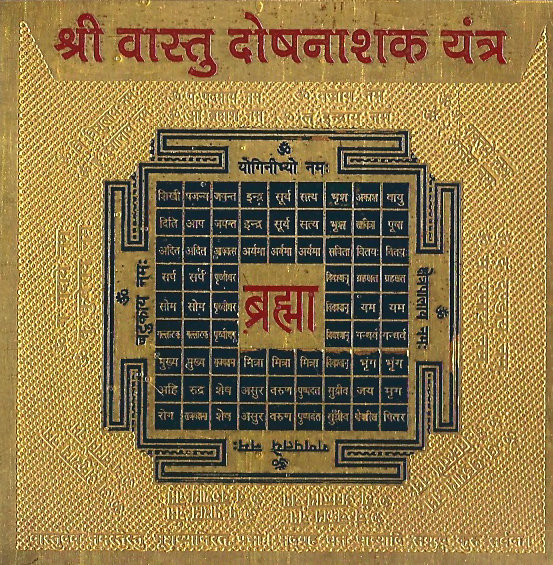
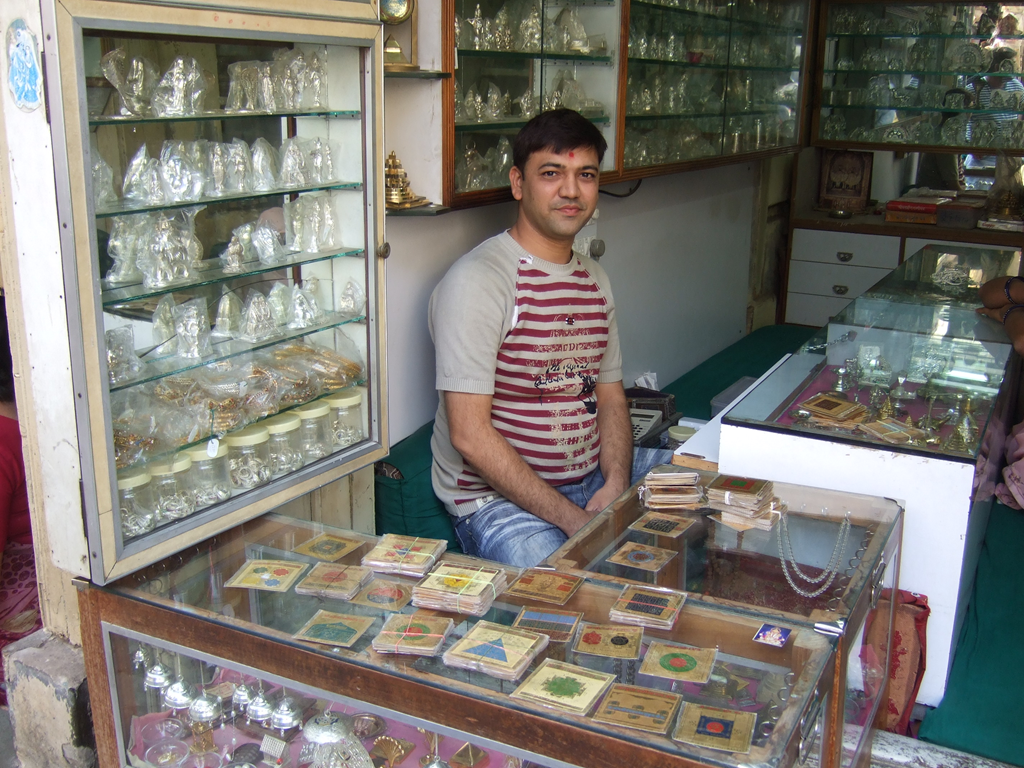
imageYantras are square charms whose power is based on words and diagrams. The above yantra was obtained from a market in Ahmedabad, India and contains the principles of India geomancy on which much architecture is based. Vastu Shastra gives particular meaning to the cardinal points. In the Vastu Purusha Mandala, the earth is represented by a square. In this case, the direction on top is east. The morning sun is considered especially powerful. While North is ruled by Kubera, the god of wealth, South is governed by Yama, or death.

From heresy to beauty products–the idea of South in France

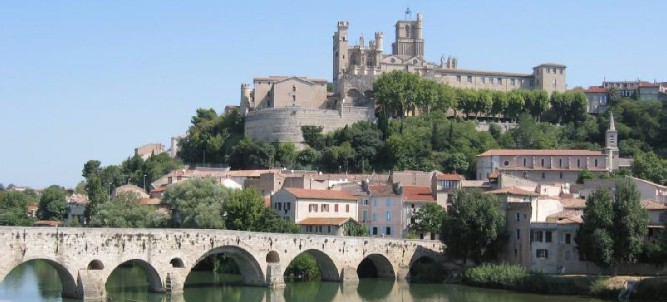
Beziers

It is tempting to position the South as a victim of the North. Certainly, the conflict between the French North and South appears to be a story of ruthless oppressor that violently subjugates a peace-loving and tolerant victim. Is that necessarily so? Whichever way, French history straddles a cultural fault-line that continues to move in opposing directions.

France contains at least two nations. While the north was populated by Franks from Germany, the south was a separate entity ruled by Visigoths in the Middle Ages. They were more closely connected laterally with the Catalans than vertically with the Franks. During its independent history, the South, known as Occitania, was a site of resistance to imperial rule.

Their first form of Christianity was Arianism, which taught that God came before Jesus. Around the tenth century, an interest in ‘courtly love’ emerged under the influence of poetry from Andalusia. The word “troubadour” was derived from an Arabic root ta-ra-ba meaning “to be transported with joy and delight”. The literary genre of ‘chanson de geste’ emerged celebrating refinement of taste in contract to the tales of war and heroic deeds prevalent in the north.

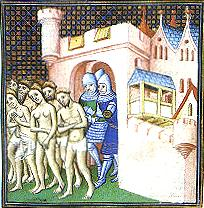
Cathars expelled from Carcassonne in 1209.
Cathars expelled from Carcassonne in 1209

At the same time, the religion of the Cathars developed, which denigrated earthly life and adopted values of simplicity and abstinence. In 1208, a Papal legate was assassinated in Saint-Gilles which prompted the Franks in support of Rome to cleanse the South of heresy. The Albigensian crusade led by Simon de Monfort became legendary for its brutality. In 1209 the town of Beziers was sacked and none of the population was spared, even those who sought refuge in the church. When the commander was asked by a Crusader how to tell Catholics from Cathars once they had taken the city, the abbot supposedly replied, Neca eos omnes. Deus suos agnoscet, “Kill them all, God will know His own.”  The second crusade against the South involved the siege of Montségur (Montsalvat) during which the inquisition was first established.

The successful completion of the crusade led to the Frankish domination of the South and the status of France as a unified country. Nonetheless, the South continued to be a source of suspicion, characterised as stubborn and greedy. During the reformation, it contained Protestant strongholds. As administration became more centralised around Paris, French was enforced as the language of administrations.

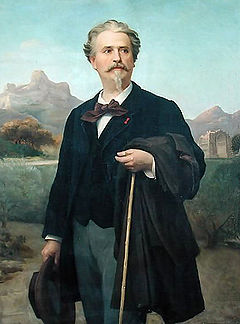
Frédéric Mistral
Frédéric Mistral

From the Revolution, the South was identified as a source of political change. Some autonomy was restored to the Midi, as it was now called. In the nineteenth century, writers such as Augustin Thierry and Michelet celebrated the South as a source of democracy. In 1854 Frédéric Mistral founded the Félibrige, dedicated to supporting Occitan literature, which gradually shifted to support for the Catholic Right. Inspired by his Nobel Prize in 1904, the Chilean poet Lucila Godoy Alcayaga changed her name to Gabriela Mistral. The mystical legend of Cathars was established by Napoléon Peyrat with the 1871 publication Histoire des Albigeois. But at the same time, there was pressure to standardise French under la Vergonha (the shaming), which prohibited the teaching of Occitan in schools. In reaction, the youth movement

Hartèra emerged to promote Occitan, as one of its posters says:

To hell with the shame…
Our patois is a language: Occitan;
Our South is a country: Occitania;

Our folklore is a culture.
We want respect for our difference.
Share, mix, walk!!

During the 1930s, there were attempts to identify the Cathars as ancestors of the Nazis, particularly through the romantic myth of Montsalvat. However, during Second World War, the area of France not occupied by Germans corresponded to that of Occitania. In 1940, editors of Cahiers du Sud, including Simone Weil and Louis Aragon called a gathering in Marseille to found a community of tolerance. As Weil said at the time, ‘Catharism was the last living expression in Europe of pre-Roman antiquity. It is from this thinking that Christianity descends; but the Gnostics, Manicheans and Cathars seem to be the only ones that remained faithful to it.’ After the war, the South became a site of creative experiment. In 1946, the Dada poet Tristan Tzara founded the Institut d’Etudes Occitanes in Toulouse.

Popular interest developed in 1960 with a two-part television series Les Cathares, drawing on Peyrat’s romantic history. The South became an issue in the revolutionary movement of May 1968

imageNow the South has become a significant luxury brand, associated with the region of Provencal in cuisine and home goods. Olivier Baussan founded the company l’Occitane, ‘L’OCCITANE has drawn inspiration from Mediterranean art de vivre and traditional Provencal techniques to create natural beauty products devoted to well-being and the pleasure of delighting and caring for oneself.’ This company has now extended its southern taste to other countries. The brand L’Occitane do Brasil expresses the authenticity of a first natural sun care line made exclusively in Brazil.

Part of the mythology of L’Occitane revolves around the ‘everlasting’ flower immortelle, the source of eternal youth.

Meanwhile, the flower has become a rallying point for revival of Occitan culture. In 1978, the band Nadau composed the song L’immortèla (The Edelweiss) which tells of the flower of love and the mountain journeys of the southern people,

Up we’ll walk, Little Peter, to the edelweiss
Up we’ll walk, Little Peter, until we find that place!

Occitania follows a familiar path in Europe, where civilisations known for their tolerance and poetry fall victim to the northern military regimes. This internal colonisation then provides the rehearsal for the subjugation of peoples beyond. Once the target of heresy has shifted to the colonies, then the internal other becomes a subject of nostalgia and commodification.

Rather than a single identity, countries like France seem constituted by a dialogue between opposing halves. While the heretic South helps to sharpen the values of the North, the brutality of the North conjures the idea of a sensual and tolerant South.